VHF and UHF
Frequency range:
- VHF: 30MHz - 300MHz
- UHF: 300MHz - 3GHz
The carrier is sinusoidal signal used to transport (carry) voice/data through space (air).
The carrier itself contains no information.
Information is added by modifying one of the carrier's parameter:
- Amplitude (AM)
- Frequency (FM)
Note:
- Human voice: 300Hz - 3.4kHz
Frequency/Wavelength
$$ c = f \lambda $$
Where:
- (v) = propagation speed (~3×10⁸ m/s in free space)
- (f) = frequency (Hz)
- (λ) = wavelength (meters)
Antenna
An antenna is efficient when it's length is comparable to a fraction of the wavelength - typically λ/4)
VHF:
FM broadcast radio: 88-108MHz, let's say carrier is 100MHz
$$ \lambda = \frac{3 \times 10^{8}}{100 \times 10^{6}} $$
$$ \lambda = 3 \text{ meters} $$
So, with λ/4 'rule', the antenna should be:
$$ \lambda/4 = 0.75 \text{ meters} $$
Trust me I'm stupid:
Human Voice transmitted without modulation - 1kHz:
$$ \lambda = \frac{3 \times 10^{8}}{100 \times 10^{3}} $$
$$ \lambda = 300,000 \text{meters} $$
Antenna would be:
$$ \lambda/4 = 75 \text{ km} $$
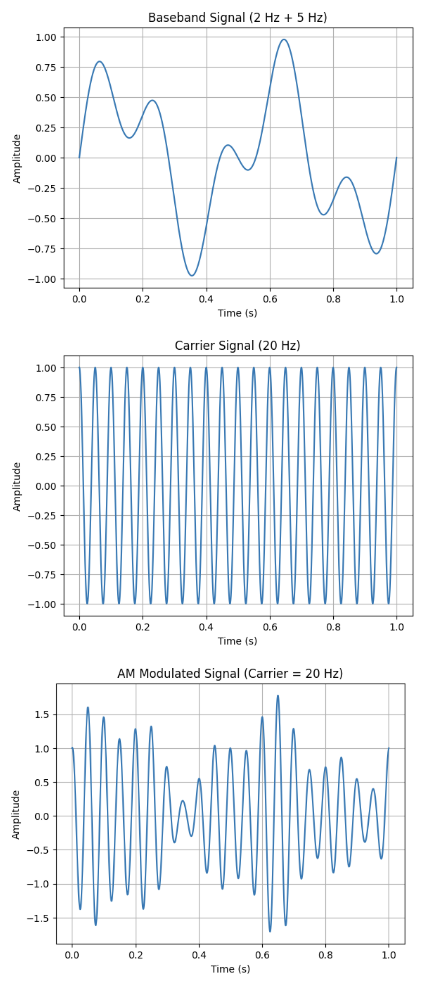
AM - NOT USED IN VHF/UHF
The modulating signal (here analog) is combined with carrier signal to produce modulated signal:
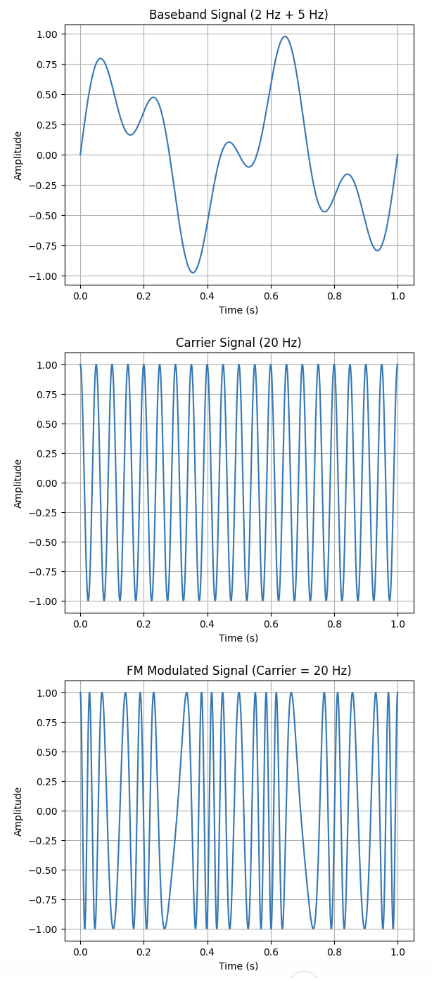
FM - USED IN VHF/UHF
Used in VHF and UHF Communications:
- Better resistance to noise and interference.
- More efficient use of power for portable and mobile devices.
- Less susceptible to fading and atmospheric disturbances compared to AM.
The modulating signal (here analog) is combined with carrier signal to produce modulated signal:
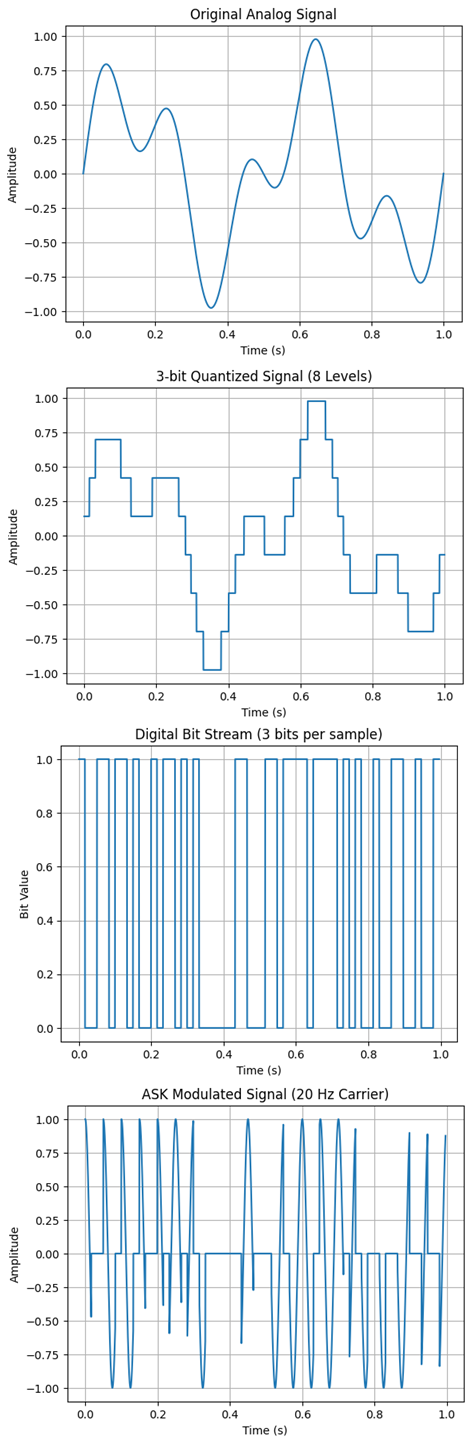
ASK - Amplitude Shift Keying
The modulatin signal - DIGITAL - is combined with carrier signal to produce modulated signal:
FSK - Frequency Shift Keying
MISSING :(
FFT - Reveals the frequency components of a signal
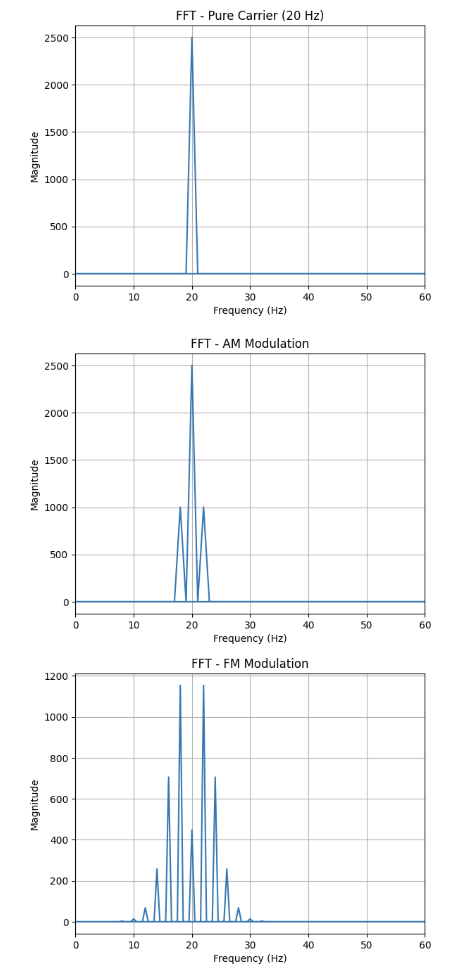
The modulated signal creates sidebands around the carrier frequency: the bandwidth increase.
In VHF/UHF, using FM for Voice Communications, Typical bandwidth is 12.5 kHz (narrowband) or 25 kHz (wideband) per channel.
If you have a 1 MHz frequency range - around the carrier frequency:
- With 25 kHz channels: 40 channels (1,000,000 Hz / 25,000 Hz).
- With 12.5 kHz channels: 80 channels (1,000,000 Hz / 12,500 Hz).